
Thoughts on Futility
Maybe Sisyphus is Happy

Hello, All,
Here we are, mercifully welcoming the end of 2025 and trepidatiously heading into 2026. This will not be a post about resolutions or life-changing philosophies. I’ve been thinking a lot about futility.
Recently while watching IT: Welcome to Derry, I longed to be in Derry facing down Pennywise rather than dealing with the prosaic but stressful real troubles of adulthood. Non-horror people always wonder why we lovers of the unquiet coffin want to welcome the darkness into our lives. Horror isn’t about the monsters or the body count. It’s about courage, about standing against that darkness. It’s about not looking away, and not running away.
You want to fill your head with happy thoughts all the time (“The bigger my toothy grin is/The smaller my troubles grow/The louder I say, ‘I’m happy’/The more I believe it’s so”)—how then will you react when there’s monsters to fight?
But, man, it’s exhausting, fighting these “real” monsters. Bring on Pennywise.
(Or, as Stranger Things comes to a conclusion tomorrow, bring on the demogorgons and Vecnas and Mind Flayers. Of interest, to me anyway, is my post about the first season when it premiered in July 2016. It’s been a fun ride!)
Of course, sometimes the monster eats you.
Fighting some monsters, it’s futility all the way.
If something is futile, it isn’t worth it. Except, decrying something as futile means there’s a specified result, a desired outcome. You fight a monster and it kills you, but before you died you found courage within yourself. Does your death make it futile?
Or much lower stakes: one of my students studies for her Regents exam, fails, and declares all that studying to be a waste of time. She didn’t reach her goal and therefore, the effort was futile.
I write a book and it doesn’t get published. Or it does, but no one reads it. Or it’s read and dismissed as subpar. All the effort, the imagination, the time—is it all for nought?
What makes “effort” worth it?
The current novel I’m querying has surpassed 50 agent rejections. I wrote the entire novel by hand back in late 2020 and early 2021. Here we are going into 2026 and maybe all that effort was for nought.
Then again, hope springs eternal. An agent recently requested the full manuscript. As a writer, you’re always on the cusp of something big or simply staying as is. Say I get an agent, a publisher, a noted release of my work. I’m “breaking out.” Or say that doesn’t happen. Say I get up to 100 or 150 rejections.
Does one outcome make my effort futile and the other worth it?
I think of James Lee Burke from an old interview saying essentially, no matter what happened with his work, he wrote. When no one wanted his work, he wrote. When he was a top bestseller in high demand, he wrote.
Keep writing.
We writers are always about to break big or about to quit.
We’re going to die eventually, so isn’t it all futile?*
Then again, think of poor Sisyphus doomed to push that rock for all eternity. Camus proposes maybe we can imagine Sisyphus happy. Push the rock to the top, watch it roll all the way back down, and stroll down behind it, grinning maybe for the respite and recharge before the next push.
You know that truism about the journey not the destination? It’s funny when I think of a few years back it’s my wife and I in Acadia National Park footing it up Cadillac Mountain. There’s maybe a dozen other hikers going on foot as hundreds of others are bumper-to-bumpering it in their cars so they can stretch their legs at the peak and take group photos.
Photos don’t do any of it justice, the vista, the magnitude, the sense that this world you’re meant to breathe it in. We reach the top, take our photos, eat a sandwich, and quadbust it back down. There’s a gift shop at the peak and a weathered marker. It’s not very interesting. The vista fills the eye, but you can’t live there. The hike up, though, that’s where you live. You feel yourself living with every strained breath, every muscle-tensed step, every bead of sweat along your back.
Is the peak supposed to be happiness? The hike, the hard work to get there? Don Draper says, “What is happiness? It’s a moment before you need more happiness.” Draper’s cynical pitch isn’t wrong, alas. We’re all of us questing after that next dopamine-rush of happiness. Chasing the addict’s dragon, as it were.
There’s an Ethan Hawke quote about how the warmth of the spotlight makes regular light feel cold. We want the praise, the glory, the rush of being special.
What’s a writer to make of this?
[Side note: This is where I tangented into a rant about AI, which I then turned into a separate post. My point: Real writers don’t use AI. Instead of hiking the mountain, you drove your car and then showed off the pictures like you earned them.**]
I think of The Shawshank Redemption. Andy is meticulous and disciplined. The last several pages of Stephen King’s novella is some of his most powerfully emotive writing, and the movie’s ending demands a standing ovation as you dry your eyes. But is Andy’s journey (and Red’s) only worth it because of that final shot on the beach? Go back to King’s novella. Look at how it concludes:
I find I am excited, so excited I can hardly hold the pencil in my trembling hand. I think it is the excitement only a free man can feel, a free man starting a long journey whose conclusion is uncertain.
I hope Andy is down there.
I hope I can make it across the border.
I hope to see my friend and shake his hand.
I hope the Pacific is as blue as it has been in my dreams.
I hope.
That’s everything, isn’t it?
The hope.
So, what is my writer’s journey? What is my literary mountain? What is my hope?
Josh Malerman, in his recent and damn amazing Watching Evil Dead: Unearthing the Radiant Artist Within, tackles this very idea at its most essential: What does a writer deserve?
I write slowly. And right now, I’m writing two different works completely longhand, which makes it even more slow. This forces me to be present. It’s just me and the page and the characters running around inside my head.
I linger in the imaginary. I live there.
Of course, as Stephen Graham Jones says, a book isn’t really complete until it has a reader.
My work can’t have any readers until it’s written.
I tend to presuppose failure, playing out inevitable disappointment (the book isn’t as good as I wanted, no one will want to read this thing, forget ever publishing it, wow, you really wasted your time, talk about futile!), but what if I dared to be like Red at the end of Shawshank and simply had hope?
What kind of writing life do I want?
When I told a fellow writer that I write longhand, he marveled in awe but when I said some days I’m only writing a paragraph, he shook his head.
I am not the tortured artist, not the wordsmith agonizing over my creations, but maybe I am going a little too slowly. I’ve been thinking of buying a cheap laptop for writing on the go. But should efficiency and productivity be my goal? I’ve got so many stories in my head, how am I ever going to get them written if I don’t speed up?
Or maybe it’s all futile.
Sobelo Books published my novella Empty Devils back in March and those who’ve read it have seemed to like it a great deal. The fact remains: it didn’t sell much and that is in large part because I haven’t hustled on its behalf. I should promote my work more. Put myself out there. What Gabino does. What Chapman does. What Fracassi does. What Panatier does. What Rebelein does. But I should also be careful what I wish for. Paul Tremblay says success is good stress but it’s still stress. Am I afraid of success? Afraid of failure? Afraid of putting in all that effort for it to be futile?
How much work do I want to do? How many conventions do I want to attend? How many posts about my work do I want to write? How much hustle do I really want to do? Years ago, Scott Spencer told me that you can’t be a writer if you need security. You must embrace the instability (creatively and financially) of the writing life. But what is success? Publishing with a Big 5? Signing a big contract? Connecting with readers? Getting a movie deal? If none of that happens, is it all futile?
When a writer suggests maybe I should redefine what success looks like to me, isn’t that basically saying that I’m never going to “break big”? And if that’s true, why bother at all?
A friend remarked a while back that I wasn’t “exactly setting the world on fire” with my writing, which I think is almost a verbatim insult from A Long Day’s Journey into Night. Insult or not, he isn’t wrong.
But again, does it matter?
Must I have “big” success for my writing to not be futile? When I turn pen to paper, am I “carrying the fire,” as it were?++
Can the answer be so simple? Focus on what matters. The work. And the work of others. Be grateful.
Camus says we should imagine Sisyphus happy.
I picture myself hiking Cadillac Mountain, and I think maybe I can at least try.
What about potential readers? Maybe people want escapism, fantasy, romantasy, etc., and I get that. Me? I’m wielding my words to exact revenge and punishment upon those who are attacking the very tenets of what I hold sacred: freedom of speech, freedom of imagination, freedom of opportunity. I’m bringing on the monsters, I’m refusing to look away, and I’m hoping I can find the courage no matter the outcome.
The 2025 Recap
Work published:
Empty Devils, Sobelo Books, March 2025
“The Ten-Dollar Preacher,” Shotgun Honey, July 2025 (Look what Stephen Graham Jones said about it! )
“La Lechuza” Last Girls’ Club December 2025
So, Empty Devils is me against the proliferation of modern-day Nazis, “The Ten-Dollar Preacher” is me taking on religious con-artist grifters, and “La Lechuza” is me against heartless ICE agents targeting children.
Yeah, that’s 2025.
Oh! Bonus micro-story published by the wonderful Cynthia Pelayo:

Podcast Appearances:
Convention Appearances:
AuthorCon, Williamsburg, VA
An attendee glanced at my book What Ever Happened to Jo Rose? and said, “Who cares?” She walked off laughing. However, I was the lead-off performer for the infamous Gross-Out Contest (an event I won in a few years ago), and my performance was dubbed “the standard for all others.”
Horror Reader Weekend, Fredericksburg, VA
I had a great time hanging with Chapman, Rebelein, Panatier, and Marino. Additionally, I performed my piece “What Kind of Writer” for Chapman, who loved it.
Fall Foliage Festival, Port Jervis, NY
A reader came up to tell me the book she bought from me last year was terrible, but she’s willing to give me one more shot. Gee, thanks for the kindness!
Horror Reader Weekend, Bear Mountain, NY
Best convention there is. I placed second in the Novel Pitch Olympics, and performed an excerpt from The Hands of Onan to the outrageous (or outraged?) laughter of the audience. Loved it.
Newsletter Highlights:
Five Questions with [Author] Interviews: Chris Panatier, Kat Silva, Sam Rebelein, Jonathan Janz, Eleanor Johnson, and Philip Fracassi.
I loved those mini-interviews, so maybe we’ll do a few more in 2026. If you missed any, they’re all available in my previous posts.
Final Thoughts:
David Lynch died in January and Rob Reiner died in December. We started the year by losing our sense of the absurd and we’re ending it by losing our heart.
Maybe it is all futile.
You climb the mountain, but there’s always another, and another, and eventually you die.
It is absurd. And that is exactly why we must not lose our heart.
Where does that leave me?
A student recently asked what I’ll do after I retire. I told him I planned on volunteering all my time at animal shelters. “You still going to write?” he asked. I gave him the same answer I give when a colleague asks if I’m still writing or a friend asks if I’m writing something new: “Always.”
Be well, be happy, be kind,
Chris DiLeo
“Remember that hope is a good thing, maybe the best of things, and no good thing ever dies."
*I read Wally Lamb’s excellent The River is Waiting, and I bet lots of readers were none too happy about the ending: all that struggle, that investment in character, for it to end this way? Is that futile? If so, then every life is.
**Yesterday, I started grading eleventh grade honors essays and discovered over 30% of them used AI in some capacity. I’m at something of an existential crossroads here. I’m vehemently anti-AI, and yet the world has seemingly embraced it, flooding social media with AI slop and hijacking employment in the name of efficiency and profit. Can AI be used to help make my students “better” writers or will it simply polish out their voice until every essay is clear, concise, and exactly identical to every other?
+Fittingly, I also finished watching Pluribus yesterday. It’s a slow burn, as we say, but it is also a brilliant indictment of conformity and its parallels to the AI-takeover, whether intended or not, is striking. THIS moment will be my anchor as I fight the AI hive mind.
++A reference to Cormac McCarthy’s The Road, in which “carrying the fire” means preserving humanity, being the good guys, fighting the good fight.
P.S. I can’t promise this newsletter will be delivered with any sort of regularity in 2026. I hope that whatever I do send out is worth both your time and mine.
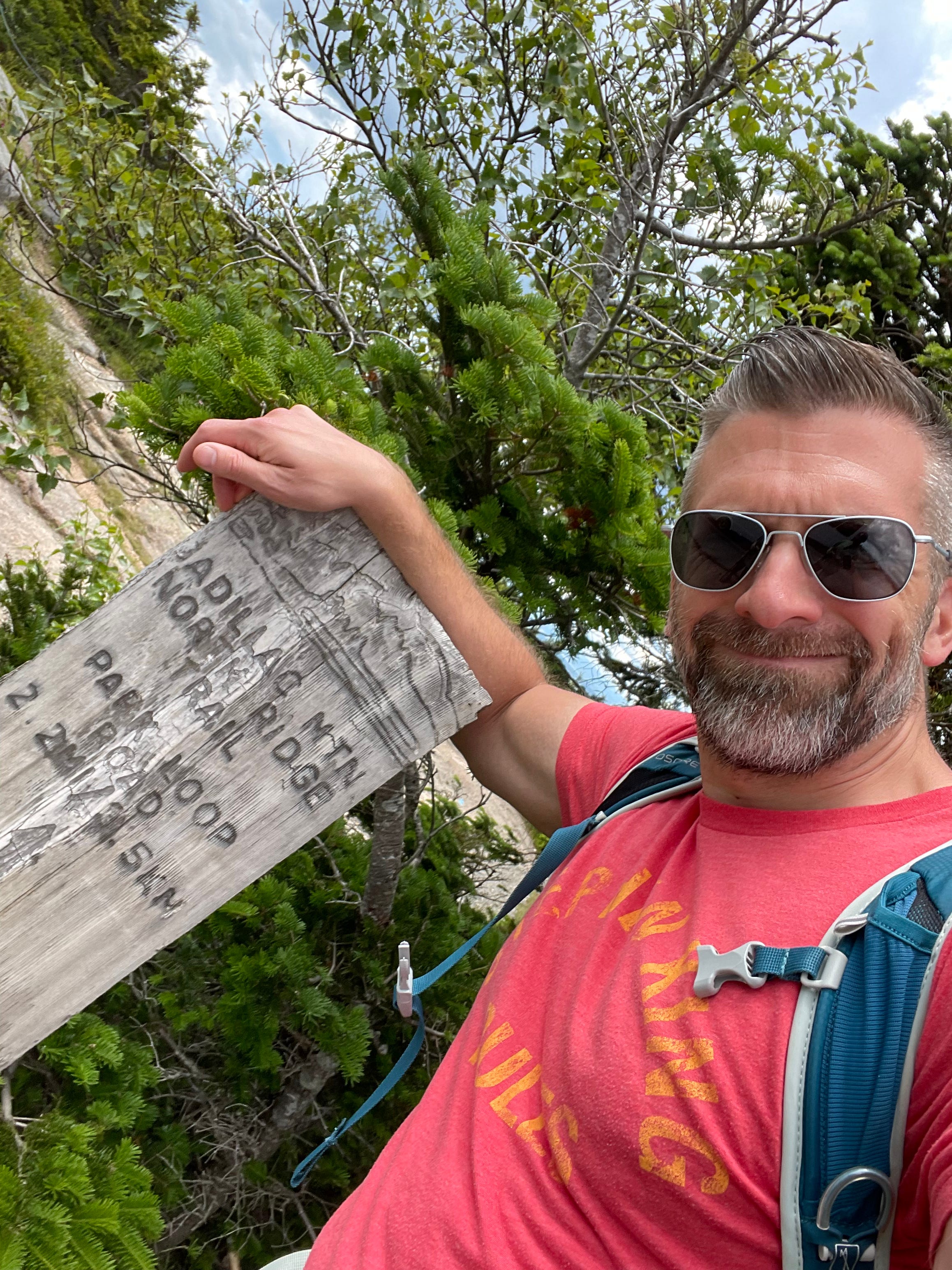
Look at that weather-beaten marker. It ain’t about what’s at the top. It’s about the willingness to trek up the mountain.
Hanging with you at events and living in the world you created in EMPTY DEVILS were highlights of my 2025, brother. Keep the stack flowing, I’m a forever fan.